Literature digest
Wolverine
BPC-157 + TB-500 research blend · identity-verified
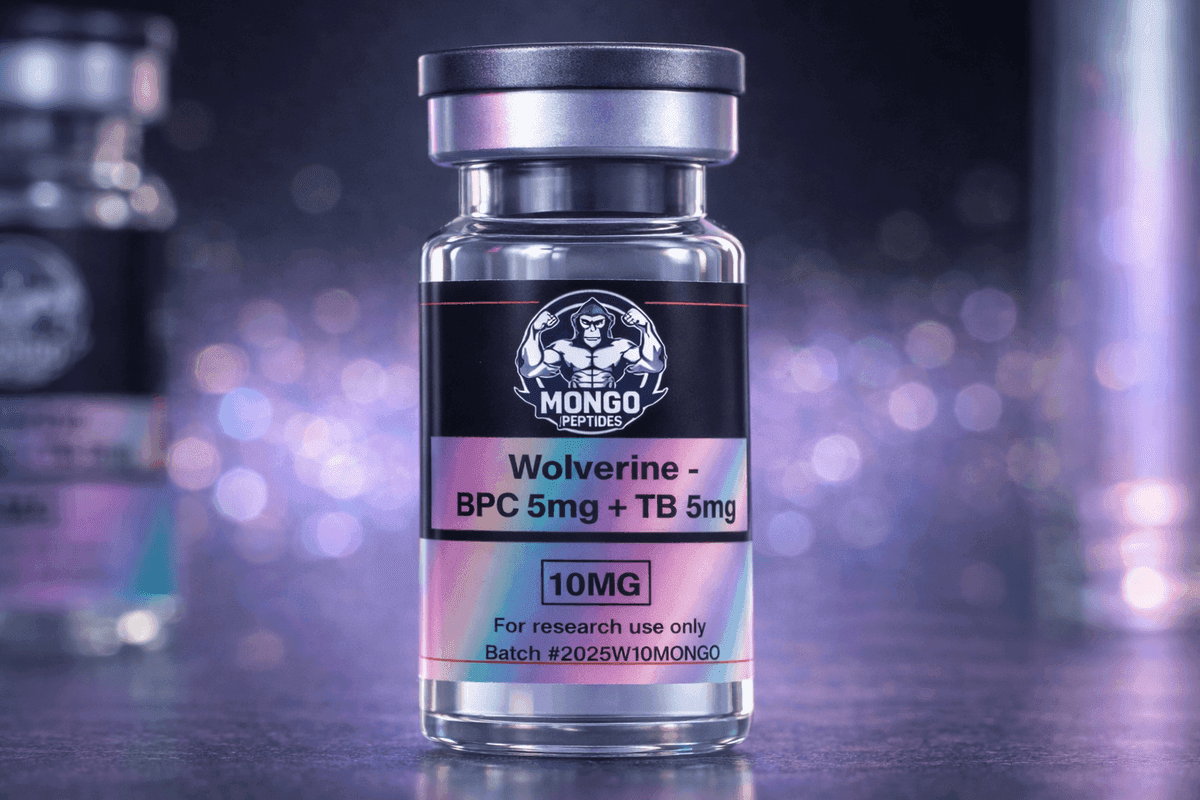
Wolverine pairs two of the most-studied tissue-repair research peptides — BPC-157 and TB-500 — whose published literatures sit on complementary axes: localized soft-tissue repair and systemic migration/survival signaling. The combination is studied together for that dual-mechanism rationale. All findings below are preclinical (animal and in-vitro); none establish human outcomes.
Chemical / structural context: Structural context: BPC-157 is a stable synthetic 15-amino-acid sequence derived from a gastric protein; TB-500 is a synthetic fragment of the actin-binding peptide thymosin β4. The two are studied as a pair because their reported activities map to local repair (BPC-157) and systemic cell-migration/angiogenesis (thymosin β4) respectively.
Key Facts
- Compound
- Wolverine
- Class
- BPC-157 + TB-500 research blend
- Evidence level
- Preclinical
- Verification
- Batch identity + purity confirmed by HPLC and mass spec; matches public COA #2604020202 (Freedom Diagnostics)
- Availability
- Available as a research material →
- Status
- Research use only — not for human consumption
Evidence signals that strengthen confidence
- BPC-157: in-vitro Achilles-tendon fibroblasts (0.5-2 µg/mL) showed concentration-dependent migration and survival changes (Chang et al., J Appl Physiol 2011).
- Thymosin β4: promoted cardiac-cell migration and survival via integrin-linked kinase in animal injury models (Bock-Marquette et al., Nature 2004).
- Evidence level: extensive preclinical replication across tissue types; no human clinical efficacy trials exist for either compound.
From the published abstracts
“BPC 157 … increased the survival and accelerated the migration of tendon fibroblasts.”
BPC-157: three decades of soft-tissue-repair literature
BPC-157 is a synthetic 15-amino-acid sequence derived from a protein found in human gastric juice, studied in published animal and in-vitro work since the early 1990s. The most replicated theme is connective-tissue repair: in a frequently cited in-vitro study (Chang et al., J Appl Physiol 2011), cultured Achilles-tendon fibroblasts exposed to BPC-157 at 0.5-2 µg/mL showed concentration-dependent increases in cell migration and survival, with the authors implicating the FAK-paxillin pathway. A 2019 review (Gwyer et al., Cell Tissue Res) catalogued preclinical reports across tendon, ligament, muscle, and bone models. Important framing for researchers: this body of evidence is preclinical — the authors themselves note the absence of human clinical trials, and findings in animal models do not establish human outcomes.
TB-500 / thymosin β4: the systemic-repair half
TB-500 is a synthetic fragment corresponding to an active region of thymosin β4, a naturally occurring actin-binding peptide. Where the BPC-157 literature centers on localized repair, the thymosin β4 literature is studied more in terms of systemic processes — cell migration, angiogenesis, and survival signaling. Bock-Marquette et al. (Nature 2004) reported that thymosin β4 promoted cardiac-cell migration and survival via integrin-linked kinase in animal injury models, and reviews by Goldstein (2005) and Philp & Kleinman (2010) summarize dermal, corneal, and cardiac repair endpoints across preclinical work. This complementary local-plus-systemic framing is the stated rationale researchers give for studying the two peptides as a pair.
On the angiogenesis question (read this honestly)
Because some preclinical reports associate BPC-157 with angiogenic signaling (e.g., VEGFR2 pathway involvement; Seiwerth et al., 2018), a recurring question in the research community is whether that activity could be undesirable in the context of existing tumors. The honest state of the evidence: there is no human study linking BPC-157 to tumor formation, and the angiogenesis discussion is drawn from animal and cell models. Nothing here should be read as a safety assurance. This page does not claim BPC-157 is safe, and any work involving subjects with cancer or other active disease is a question for a qualified clinician — not a peptide page. Regulatory note: the FDA placed BPC-157 in a category restricting compounding in 2024; this material is provided strictly for laboratory-research context.
Storage and handling context (catalog-linked)
Catalog format: lyophilized research material as presented on the storefront listing.
In-stock listing sizes: 10mg.
Laboratory handling note: publications in this field typically report controlled storage, chain-of-custody documentation, and method-specific reconstitution procedures under institutional SOPs. This site does not provide dosing, administration, or protocol instructions.
Linked study sources
These links point to external source records (PubMed / journal pages) for independent verification.
The promoting effect of pentadecapeptide BPC 157 on tendon healing involves tendon outgrowth, cell survival, and cell migration
Chang CH et al. · Journal of Applied Physiology · 2011
In an in-vitro model, researchers reported that BPC 157 increased the survival and accelerated the migration of cultured Achilles-tendon fibroblasts in a concentration-dependent manner (tested at 0.5-2 µg/mL), associated with changes in the FAK-paxillin pathway.
Open source linkGastric pentadecapeptide body protection compound BPC 157 and its role in accelerating musculoskeletal soft tissue healing
Gwyer D, Wragg NM, Wilson SL · Cell and Tissue Research · 2019
A narrative review summarizing preclinical reports that BPC 157 was associated with improved healing outcomes across tendon, ligament, muscle, and bone injury models in laboratory animals; the authors note the absence of human trial data.
Open source linkBPC 157 and Standard Angiogenic Growth Factors. Gastrointestinal Tract Healing, Lessons from Tissue Pathology
Seiwerth S et al. · Current Pharmaceutical Design · 2018
A review discussing preclinical observations linking BPC 157 to angiogenic and cytoprotective signaling (including VEGFR2 pathway involvement) in animal tissue-repair models.
Open source linkThymosin β4: actin-sequestering protein moonlights to repair injured tissues
Goldstein AL, Hannappel E, Kleinman HK · Trends in Molecular Medicine · 2005
Review describing thymosin β4 (the parent peptide of the TB-500 fragment) as an actin-sequestering protein associated in animal models with cell migration, angiogenesis, and wound-repair processes.
Open source linkThymosin β4 activates integrin-linked kinase and promotes cardiac cell migration, survival and cardiac repair
Bock-Marquette I et al. · Nature · 2004
In animal cardiac-injury models, researchers reported that thymosin β4 promoted cardiomyocyte migration and survival via integrin-linked kinase and Akt signaling.
Open source linkAnimal studies with thymosin β4, a multifunctional tissue repair and regeneration peptide
Philp D, Kleinman HK · Annals of the New York Academy of Sciences · 2010
Summary of preclinical animal work on thymosin β4 spanning dermal, corneal, and cardiac repair endpoints; no human clinical efficacy claims are made.
Open source linkComparative research framing
To compare related catalog compounds: GHK-Cu adds a copper-peptide skin-remodeling literature, and the GLOW and KLOW blends layer additional components (GHK-Cu, and KPV respectively) onto this same BPC-157/TB-500 base.