Literature digest
KLOW
BPC-157 + GHK-Cu + TB500 + KPV Blend
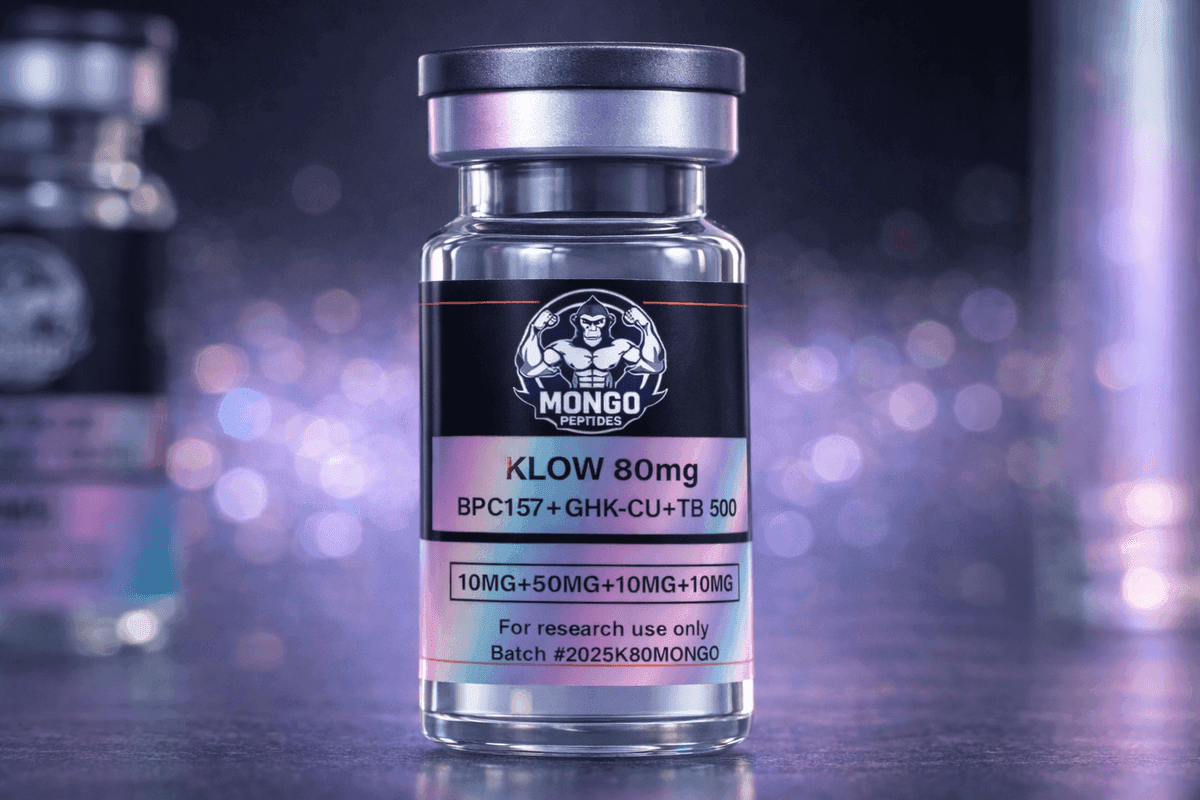
KLOW is the most layered of the repair blends: the BPC-157 + TB-500 repair base, plus GHK-Cu (dermal remodeling) and KPV (an α-MSH-derived anti-inflammatory tripeptide). It is studied as a structural-repair-plus-inflammation combination. All findings are preclinical; none establish human outcomes.
Chemical / structural context: Structural context: BPC-157 and TB-500 form the repair base; GHK-Cu is a copper tripeptide studied for skin remodeling; KPV is the Lys-Pro-Val C-terminal fragment of α-melanocyte-stimulating hormone, studied for anti-inflammatory signaling.
Key Facts
- Compound
- KLOW
- Class
- BPC-157 + GHK-Cu + TB500 + KPV Blend
- Evidence level
- Preclinical
- Verification
- Batch identity + purity confirmed by HPLC and mass spec; matches public COA #2605250129 (Freedom Diagnostics)
- Availability
- Available as a research material →
- Status
- Research use only — not for human consumption
Evidence signals that strengthen confidence
- Repair base (BPC-157 / thymosin β4): concentration-dependent migration and survival signaling across in-vitro and animal models.
- GHK-Cu: dermal-matrix remodeling and antioxidant gene modulation in laboratory work.
- KPV: reduced inflammatory markers in murine inflammatory-bowel-disease models (Kannengiesser et al., 2008).
From the published abstracts
“The melanocortin-derived tripeptide KPV has anti-inflammatory potential in murine models.”
BPC-157: three decades of soft-tissue-repair literature
BPC-157 is a synthetic 15-amino-acid sequence derived from a protein found in human gastric juice, studied in published animal and in-vitro work since the early 1990s. The most replicated theme is connective-tissue repair: in a frequently cited in-vitro study (Chang et al., J Appl Physiol 2011), cultured Achilles-tendon fibroblasts exposed to BPC-157 at 0.5-2 µg/mL showed concentration-dependent increases in cell migration and survival, with the authors implicating the FAK-paxillin pathway. A 2019 review (Gwyer et al., Cell Tissue Res) catalogued preclinical reports across tendon, ligament, muscle, and bone models. Important framing for researchers: this body of evidence is preclinical — the authors themselves note the absence of human clinical trials, and findings in animal models do not establish human outcomes.
TB-500 / thymosin β4: the systemic-repair half
TB-500 is a synthetic fragment corresponding to an active region of thymosin β4, a naturally occurring actin-binding peptide. Where the BPC-157 literature centers on localized repair, the thymosin β4 literature is studied more in terms of systemic processes — cell migration, angiogenesis, and survival signaling. Bock-Marquette et al. (Nature 2004) reported that thymosin β4 promoted cardiac-cell migration and survival via integrin-linked kinase in animal injury models, and reviews by Goldstein (2005) and Philp & Kleinman (2010) summarize dermal, corneal, and cardiac repair endpoints across preclinical work. This complementary local-plus-systemic framing is the stated rationale researchers give for studying the two peptides as a pair.
GHK-Cu: the copper-peptide remodeling literature
GHK-Cu is the copper complex of the tripeptide glycyl-L-histidyl-L-lysine, a sequence whose plasma concentration declines with age. The published literature (Pickart & Margolina, Int J Mol Sci 2018; Pickart et al., 2015) associates GHK-Cu in laboratory and animal models with skin-matrix remodeling, antioxidant signaling, and modulation of a broad set of genes related to tissue maintenance. In a blend context it is studied as the cosmetic/dermal-remodeling component alongside the BPC-157/TB-500 repair pair.
KPV: the anti-inflammatory tripeptide
KPV is the C-terminal tripeptide (Lys-Pro-Val) of α-melanocyte-stimulating hormone. Unlike the repair-oriented components, the KPV literature centers on anti-inflammatory signaling: in murine inflammatory-bowel-disease models (Kannengiesser et al., 2008) researchers associated KPV with reduced inflammatory markers, and the broader melanocortin review by Brzoska et al. (2008) documents related in-vitro and in-vivo anti-inflammatory effects. In the KLOW blend it is the component studied for the inflammation axis that sits alongside structural repair.
On the angiogenesis question (read this honestly)
Because some preclinical reports associate BPC-157 with angiogenic signaling (e.g., VEGFR2 pathway involvement; Seiwerth et al., 2018), a recurring question in the research community is whether that activity could be undesirable in the context of existing tumors. The honest state of the evidence: there is no human study linking BPC-157 to tumor formation, and the angiogenesis discussion is drawn from animal and cell models. Nothing here should be read as a safety assurance. This page does not claim BPC-157 is safe, and any work involving subjects with cancer or other active disease is a question for a qualified clinician — not a peptide page. Regulatory note: the FDA placed BPC-157 in a category restricting compounding in 2024; this material is provided strictly for laboratory-research context.
Storage and handling context (catalog-linked)
Catalog format: lyophilized research material as presented on the storefront listing.
In-stock listing sizes: Standard.
Laboratory handling note: publications in this field typically report controlled storage, chain-of-custody documentation, and method-specific reconstitution procedures under institutional SOPs. This site does not provide dosing, administration, or protocol instructions.
Linked study sources
These links point to external source records (PubMed / journal pages) for independent verification.
The promoting effect of pentadecapeptide BPC 157 on tendon healing involves tendon outgrowth, cell survival, and cell migration
Chang CH et al. · Journal of Applied Physiology · 2011
In an in-vitro model, researchers reported that BPC 157 increased the survival and accelerated the migration of cultured Achilles-tendon fibroblasts in a concentration-dependent manner (tested at 0.5-2 µg/mL), associated with changes in the FAK-paxillin pathway.
Open source linkGastric pentadecapeptide body protection compound BPC 157 and its role in accelerating musculoskeletal soft tissue healing
Gwyer D, Wragg NM, Wilson SL · Cell and Tissue Research · 2019
A narrative review summarizing preclinical reports that BPC 157 was associated with improved healing outcomes across tendon, ligament, muscle, and bone injury models in laboratory animals; the authors note the absence of human trial data.
Open source linkBPC 157 and Standard Angiogenic Growth Factors. Gastrointestinal Tract Healing, Lessons from Tissue Pathology
Seiwerth S et al. · Current Pharmaceutical Design · 2018
A review discussing preclinical observations linking BPC 157 to angiogenic and cytoprotective signaling (including VEGFR2 pathway involvement) in animal tissue-repair models.
Open source linkThymosin β4: actin-sequestering protein moonlights to repair injured tissues
Goldstein AL, Hannappel E, Kleinman HK · Trends in Molecular Medicine · 2005
Review describing thymosin β4 (the parent peptide of the TB-500 fragment) as an actin-sequestering protein associated in animal models with cell migration, angiogenesis, and wound-repair processes.
Open source linkThymosin β4 activates integrin-linked kinase and promotes cardiac cell migration, survival and cardiac repair
Bock-Marquette I et al. · Nature · 2004
In animal cardiac-injury models, researchers reported that thymosin β4 promoted cardiomyocyte migration and survival via integrin-linked kinase and Akt signaling.
Open source linkAnimal studies with thymosin β4, a multifunctional tissue repair and regeneration peptide
Philp D, Kleinman HK · Annals of the New York Academy of Sciences · 2010
Summary of preclinical animal work on thymosin β4 spanning dermal, corneal, and cardiac repair endpoints; no human clinical efficacy claims are made.
Open source linkRegenerative and Protective Actions of the GHK-Cu Peptide in the Light of the New Gene Data
Pickart L, Margolina A · International Journal of Molecular Sciences · 2018
Review describing the copper-binding tripeptide GHK-Cu and laboratory observations linking it to skin-remodeling, antioxidant, and gene-expression-modulating activity.
Open source linkGHK Peptide as a Natural Modulator of Multiple Cellular Pathways in Skin Regeneration
Pickart L, Vasquez-Soltero JM, Margolina A · BioMed Research International · 2015
Discussion of in-vitro and animal data associating the GHK peptide with collagen and dermal matrix remodeling pathways.
Open source linkMelanocortin-derived tripeptide KPV has anti-inflammatory potential in murine models of inflammatory bowel disease
Kannengiesser K et al. · Inflammatory Bowel Diseases · 2008
In murine colitis models, researchers reported that the α-MSH-derived tripeptide KPV was associated with reduced inflammatory markers.
Open source linkα-Melanocyte-stimulating hormone and related tripeptides: biochemistry, antiinflammatory and protective effects in vitro and in vivo
Brzoska T et al. · Endocrine Reviews · 2008
Review of the melanocortin peptide family (including the KPV C-terminal fragment) and its documented anti-inflammatory signaling in laboratory and animal systems.
Open source linkComparative research framing
KLOW is the four-component extension of the Wolverine/GLOW line. Compare the simpler blends to see how the repair, dermal, and anti-inflammatory literatures are studied independently before being combined.