Literature digest
GLP - 2T
Dual GIP / GLP-1 receptor agonist · identity-verified
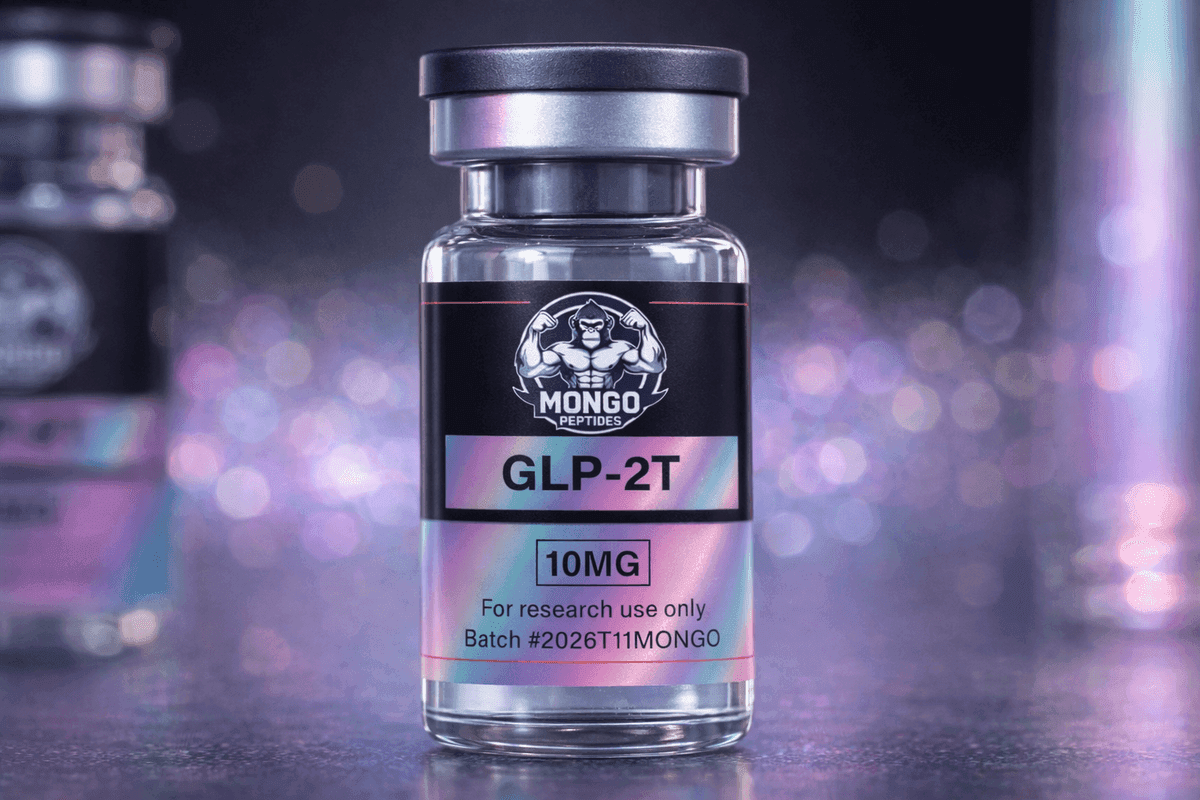
GLP - 2T became one of the most watched compounds in metabolic research because its study program moved fast from receptor theory to very large real-world trial populations. In just a few years, published teams reported detailed data from 40-week, 52-week, and 72-week trials, then extended into liver-fibrosis and cardiovascular-outcomes studies with clearly defined endpoints.
Chemical / structural context: Structural context: this class is designed to activate both GIP and GLP-1 receptor pathways. In published trials, researchers typically used once-weekly injections with staged escalation (usually from 2.5 mg up to 5 mg, 10 mg, or 15 mg) so outcomes could be compared across dose arms.
Key Facts
- Compound
- GLP - 2T
- Class
- Dual GIP / GLP-1 receptor agonist
- Evidence level
- Clinical-stage research
- Verification
- Batch identity + purity confirmed by HPLC and mass spec; matches public COA #2604020200 (Freedom Diagnostics)
- Availability
- Available as a research material →
- Status
- Research use only — not for human consumption
Evidence signals that strengthen confidence
- SURPASS-2 enrolled 1,879 participants for 40 weeks and compared 5 mg, 10 mg, and 15 mg once-weekly doses against semaglutide 1 mg — a direct active-comparator dataset rather than placebo-only evidence.
- SURPASS-3 ran at 122 sites in 13 countries over 52 weeks; reported HbA1c reductions were approximately -1.9% to -2.4% across tirzepatide arms versus -1.34% with insulin degludec, with lower reported rates of significant hypoglycemia.
- The program extended into liver-fibrosis (SYNERGY-NASH) and a large cardiovascular-outcomes trial (SURPASS-CVOT, 13,000+ participants) — an indication of how broadly the metabolic research has been studied.
From the published abstracts
“A primary end-point event occurred in 12.2% in the tirzepatide group and 13.1% in the dulaglutide group ... P = 0.003 for noninferiority.”
The research story in plain English
The main reason this compound drew so much attention is simple: researchers tested it at scale and published glycemic endpoints quickly. In SURPASS-2 (2021), Frias and colleagues randomized 1,879 people for 40 weeks and compared three once-weekly dose arms (5 mg, 10 mg, and 15 mg) with semaglutide 1 mg. Reported HbA1c changes were -2.01%, -2.24%, and -2.30% in the three dose arms versus -1.86% in the semaglutide arm — the headline being a dual-incretin glycemic effect studied head-to-head against an active comparator. Body-composition endpoints were also reported across the program.
What happened when researchers tested it in longer and tougher settings
The next big test was whether the signal held up against insulin-centered care pathways. In SURPASS-3 (Del Prato et al., 2021), researchers ran a 52-week trial at 122 sites in 13 countries with 1,444 randomized participants (1,437 in the modified intention-to-treat analysis). The protocol escalated once-weekly doses from 2.5 mg to target doses of 5 mg, 10 mg, or 15 mg, and compared them with daily insulin degludec titrated to fasting glucose targets. Reported HbA1c reductions were -1.93%, -2.20%, and -2.37% in the tirzepatide groups versus -1.34% with insulin degludec. Weight changed by -7.5 kg to -12.9 kg in tirzepatide groups versus +2.3 kg with insulin degludec. Severe or clinically significant hypoglycemia was also lower in tirzepatide groups (1-2%) than in the insulin group (7%).
How the data looked in insulin-background and longer trials
In SURPASS-5 (Dahl et al., JAMA 2022), researchers added once-weekly tirzepatide to insulin glargine in 475 participants over 40 weeks. Reported HbA1c changes were -2.11% (5 mg), -2.40% (10 mg), and -2.34% (15 mg) versus -0.86% in placebo; body-composition changes were also reported across the dose arms. A separate 72-week trial (SURMOUNT-1, Jastreboff et al., NEJM 2022) examined body-composition endpoints in 2,539 participants.
Framing note for researchers: these are published human clinical-trial findings for the molecule itself, reported by independent investigators. They are not outcomes claimed for this research-use-only product, nor guidance for any use.
Liver and cardiovascular studies: what researchers measured next
Once glycemic findings were established, published teams tested adjacent disease models. In SYNERGY-NASH (Loomba et al., NEJM 2024), 190 participants with biopsy-confirmed MASH and F2/F3 fibrosis were randomized for 52 weeks; 157 had week-52 biopsy data available for evaluation. MASH resolution without fibrosis worsening was reported in 44%, 56%, and 62% of the 5 mg, 10 mg, and 15 mg groups versus 10% with placebo. Improvement of at least one fibrosis stage without worsening MASH was 55%, 51%, and 51% versus 30% in placebo.
In SURPASS-CVOT (Nicholls et al., NEJM 2025), 13,299 participants were randomized and 13,165 entered modified intention-to-treat analysis (6,586 vs 6,579). The primary cardiovascular composite occurred in 12.2% of the tirzepatide group and 13.1% of the dulaglutide group (hazard ratio 0.92, 95.3% CI 0.83 to 1.01), meeting the trial's noninferiority test.
Storage and handling context (catalog-linked)
Catalog format: lyophilized research material as presented on the storefront listing.
In-stock listing sizes: 10mg, 15mg, 30mg.
Laboratory handling note: publications in this field typically report controlled storage, chain-of-custody documentation, and method-specific reconstitution procedures under institutional SOPs. This site does not provide dosing, administration, or protocol instructions.
Linked study sources
These links point to external source records (PubMed / journal pages) for independent verification.
Tirzepatide versus Semaglutide Once Weekly in Patients with Type 2 Diabetes
Frias JP et al. · New England Journal of Medicine · 2021
In SURPASS-2, researchers observed larger mean HbA1c reductions with tirzepatide doses than with semaglutide at 40 weeks, with body-composition differences also reported across dose arms.
Open source linkTirzepatide versus Insulin Degludec as Add-on to Metformin With or Without SGLT2 Inhibitors (SURPASS-3)
Del Prato S et al. · The Lancet · 2021
At week 52, trial reports documented HbA1c reductions ranging from approximately 1.93% to 2.37% across tirzepatide arms versus 1.34% with insulin degludec, alongside opposite-direction body-mass trends.
Open source linkEffect of Subcutaneous Tirzepatide vs Placebo Added to Titrated Insulin Glargine (SURPASS-5)
Dahl D et al. · JAMA · 2022
Researchers documented glycemic improvements and body-composition changes across tirzepatide groups versus placebo over 40 weeks in insulin-treated participants.
Open source linkTirzepatide Once Weekly for the Treatment of Obesity (SURMOUNT-1)
Jastreboff AM et al. · New England Journal of Medicine · 2022
A 72-week obesity-research trial reporting body-composition endpoints across tirzepatide dose arms versus placebo; a published human trial of the molecule in clinical research, not an outcome claimed for this product.
Open source linkTirzepatide for Metabolic Dysfunction-Associated Steatohepatitis with Liver Fibrosis
Loomba R et al. · New England Journal of Medicine · 2024
In SYNERGY-NASH, researchers reported MASH resolution without fibrosis worsening in 44%-62% of tirzepatide groups versus 10% in placebo at 52 weeks.
Open source linkCardiovascular Outcomes with Tirzepatide versus Dulaglutide in Type 2 Diabetes (SURPASS-CVOT)
Nicholls SJ et al. · New England Journal of Medicine · 2025
Among 13,165 participants in modified intention-to-treat analysis, the primary MACE endpoint occurred in 12.2% versus 13.1% (hazard ratio 0.92; 95.3% CI, 0.83 to 1.01), meeting noninferiority criteria.
Open source linkComparative research framing
If you want to compare related catalog compounds next, start with GLP - 3RT for broader receptor-coverage research framing, NAD+ for mitochondrial/cofactor literature, and SS-31 for membrane-level bioenergetics studies. Those pages show how different research communities define endpoints, durations, and replication standards.