Literature digest
GHK-Cu
Copper Peptide Complex
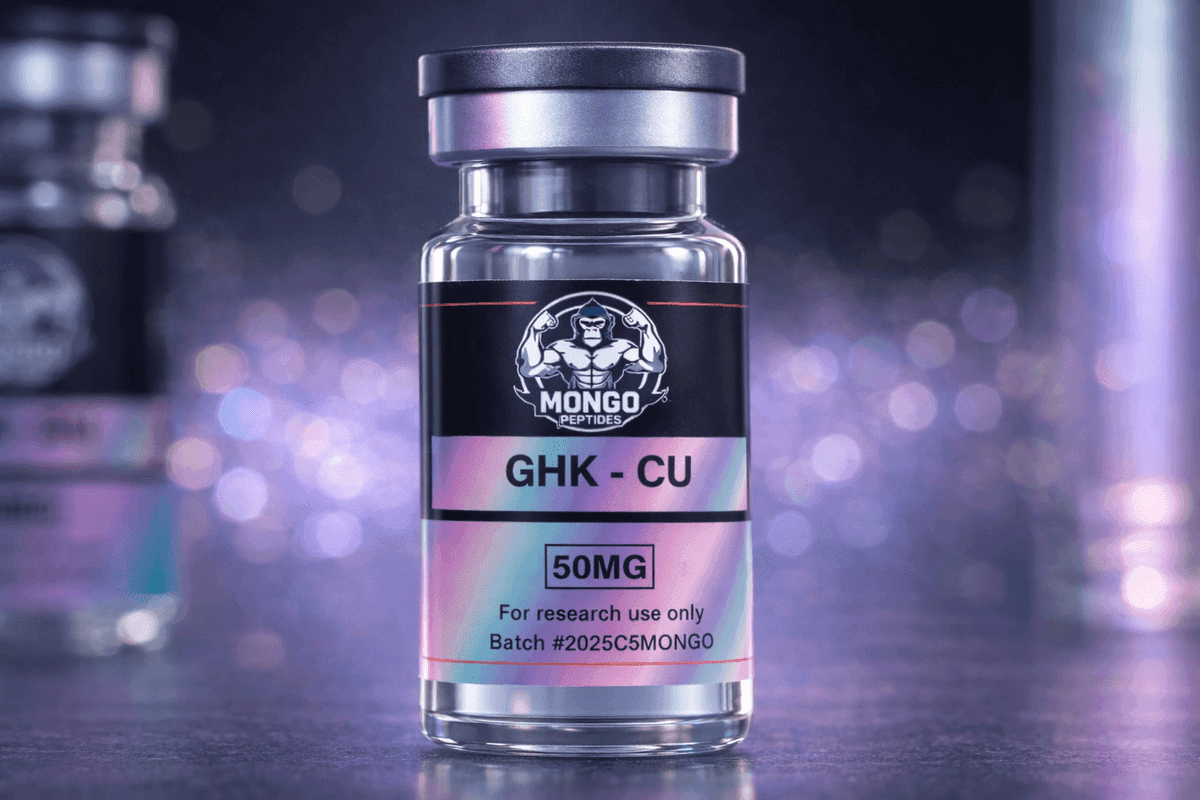
GHK-Cu is one of the more thoroughly characterized cosmetic-and-regenerative research peptides: a small copper-binding tripeptide whose published literature centers on skin-matrix remodeling, antioxidant signaling, and broad gene-expression modulation. This digest summarizes that third-party work in academic terms only; none of it constitutes treatment or human-use guidance.
Chemical / structural context: Structural context: GHK is the tripeptide glycyl-L-histidyl-L-lysine; GHK-Cu is its complex with copper(II), which the peptide binds with high affinity. Plasma GHK concentration is reported to decline with age, which is part of why researchers study supplementation in remodeling models.
Key Facts
- Compound
- GHK-Cu
- Class
- Copper Peptide Complex
- Evidence level
- Preclinical + cosmetic
- Verification
- Batch identity + purity confirmed by HPLC and mass spec; matches public COA #2605250127 (Freedom Diagnostics)
- Availability
- Available as a research material →
- Status
- Research use only — not for human consumption
Evidence signals that strengthen confidence
- Pickart & Margolina (Int J Mol Sci 2018) reviewed laboratory data associating GHK-Cu with skin-remodeling, antioxidant, and anti-inflammatory signaling.
- Pickart et al. (2014) discussed in-vitro gene-expression data describing directional shifts across a large number of human genes toward a tissue-maintenance profile.
- Evidence level: substantial in-vitro and animal data plus cosmetic-context human use; not framed here as a medical treatment.
From the published abstracts
“GHK … acts as a natural modulator of multiple cellular pathways in skin regeneration.”
What GHK-Cu is
GHK is a naturally occurring tripeptide (glycyl-L-histidyl-L-lysine) first isolated from human plasma; GHK-Cu is its copper complex. The peptide binds copper(II) with high affinity, and its plasma level is reported to fall with age. The published interest centers on the observation that GHK-Cu participates in skin and connective-tissue remodeling — which is why it appears both in dedicated cosmetic research and as a component of repair-oriented research blends.
The skin-remodeling and antioxidant literature
The most developed body of work comes from Loren Pickart and colleagues. Their reviews (Int J Mol Sci 2018; BioMed Res Int 2015) summarize laboratory and animal observations associating GHK-Cu with dermal-matrix remodeling (collagen and related structural proteins), antioxidant activity, and anti-inflammatory signaling. In a blend context these are the properties studied alongside the BPC-157/TB-500 repair pair.
The gene-expression ('genome resetting') work
A distinctive thread in the GHK literature is gene-expression modulation. Pickart et al. (2014) discussed in-vitro data describing directional shifts across a large number of human genes toward a tissue-maintenance profile. This is laboratory gene-expression work — it describes cellular signaling, not a clinical outcome — but it is the basis for much of the longevity-adjacent research interest in the peptide.
The honest evidence picture
GHK-Cu has a deep in-vitro and animal literature, plus a real cosmetic-use human history (topical formulations). What it does not have is a body of large randomized clinical trials for systemic outcomes. The appropriate framing is therefore: well-characterized cellular and dermal-remodeling signaling, studied primarily in laboratory, animal, and cosmetic-topical contexts. Nothing here is dosing or treatment guidance; it is research context only.
Storage and handling context (catalog-linked)
Catalog format: lyophilized research material as presented on the storefront listing.
In-stock listing sizes: 50mg, 100mg.
Laboratory handling note: publications in this field typically report controlled storage, chain-of-custody documentation, and method-specific reconstitution procedures under institutional SOPs. This site does not provide dosing, administration, or protocol instructions.
Linked study sources
These links point to external source records (PubMed / journal pages) for independent verification.
Regenerative and Protective Actions of the GHK-Cu Peptide in the Light of the New Gene Data
Pickart L, Margolina A · International Journal of Molecular Sciences · 2018
Review describing the copper-binding tripeptide GHK-Cu and laboratory observations linking it to skin-remodeling, antioxidant, and gene-expression-modulating activity.
Open source linkGHK Peptide as a Natural Modulator of Multiple Cellular Pathways in Skin Regeneration
Pickart L, Vasquez-Soltero JM, Margolina A · BioMed Research International · 2015
Discussion of in-vitro and animal data associating the GHK peptide with collagen and dermal matrix remodeling pathways.
Open source linkGHK and DNA: Resetting the Human Genome to Health
Pickart L, Vasquez-Soltero JM, Margolina A · BioMed Research International · 2014
Review describing in-vitro observations that the GHK peptide modulates a broad set of human genes (the authors discuss directional shifts across thousands of genes in cultured systems) toward a tissue-maintenance profile.
Open source linkThe human tri-peptide GHK and tissue remodeling
Pickart L · Journal of Biomaterials Science, Polymer Edition · 2008
Foundational review of GHK and its copper complex in tissue-remodeling and wound-research contexts, summarizing in-vitro and animal observations.
Open source linkComparative research framing
GHK-Cu also appears as the dermal-remodeling component of the GLOW and KLOW research blends. Compare those pages to see how the copper-peptide literature is studied alongside BPC-157/TB-500 repair and (in KLOW) the KPV anti-inflammatory tripeptide.